For a course on ICT project management, a team of seven of us planned and tracked a hypothetical IoT project end to end: AquaGuard, a smart aquaculture system that would monitor water quality on fish farms, pH, dissolved oxygen, temperature, turbidity, via sensors, alert operators through a mobile app when something's off, and feed the data into a cloud dashboard. The point of the assignment wasn't to physically build the hardware; it was to run real project management discipline around a project shaped like a real one: work breakdown, tracking, change control, quality, and vendor selection, all in Jira.
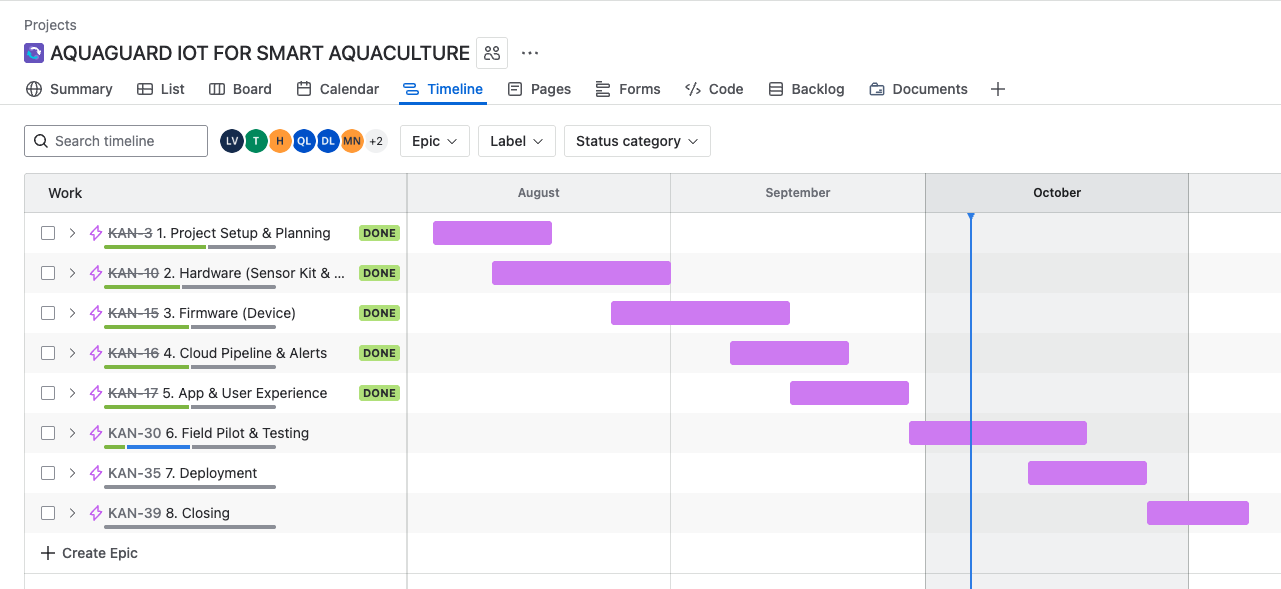
My part was defining the work packages and the deliverables tied to them. I broke the project into eight work packages, from initial setup and planning through hardware, firmware, the cloud pipeline, the app, field testing, deployment, and closing, each split into second-level tasks so the team could track progress and assign ownership. Those became Epics in Jira, sequenced on a timeline: planning first, then hardware, firmware, the cloud pipeline, and the app running through August and September, moving into field testing and deployment, and closing out by early November.
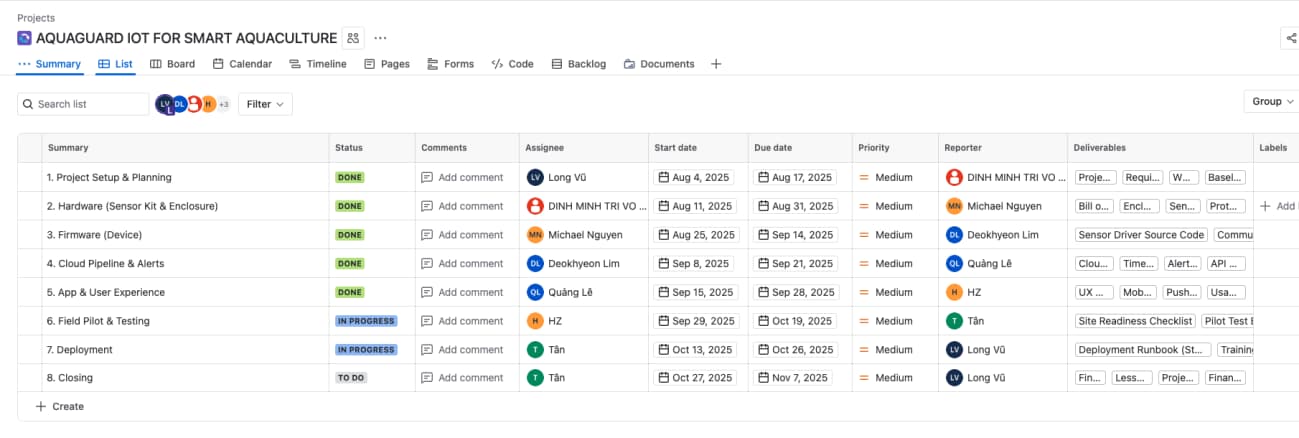
For each work package I defined the concrete outputs it needed to produce: a project charter and RACI chart for the planning phase, a bill of materials and calibration procedure for the hardware phase, source code and a security test report for the firmware, a final report and handover package for closing, and so on. Tracking deliverables as a field on each Jira Epic meant the team could see exactly what still needed producing, not just which tasks were ticked off.
The rest of the team built the other project-management pieces around that structure: a live dashboard rolling up status across every work package, a formal change-request workflow (used for real example requests like upgrading sensor accuracy or adding offline mode to the app), an issue log, quality audits against a hardware checklist, an Ishikawa diagram investigating why the alerting model might throw false positives, and a vendor scorecard comparing three IoT sensor suppliers on accuracy, cost, and support.
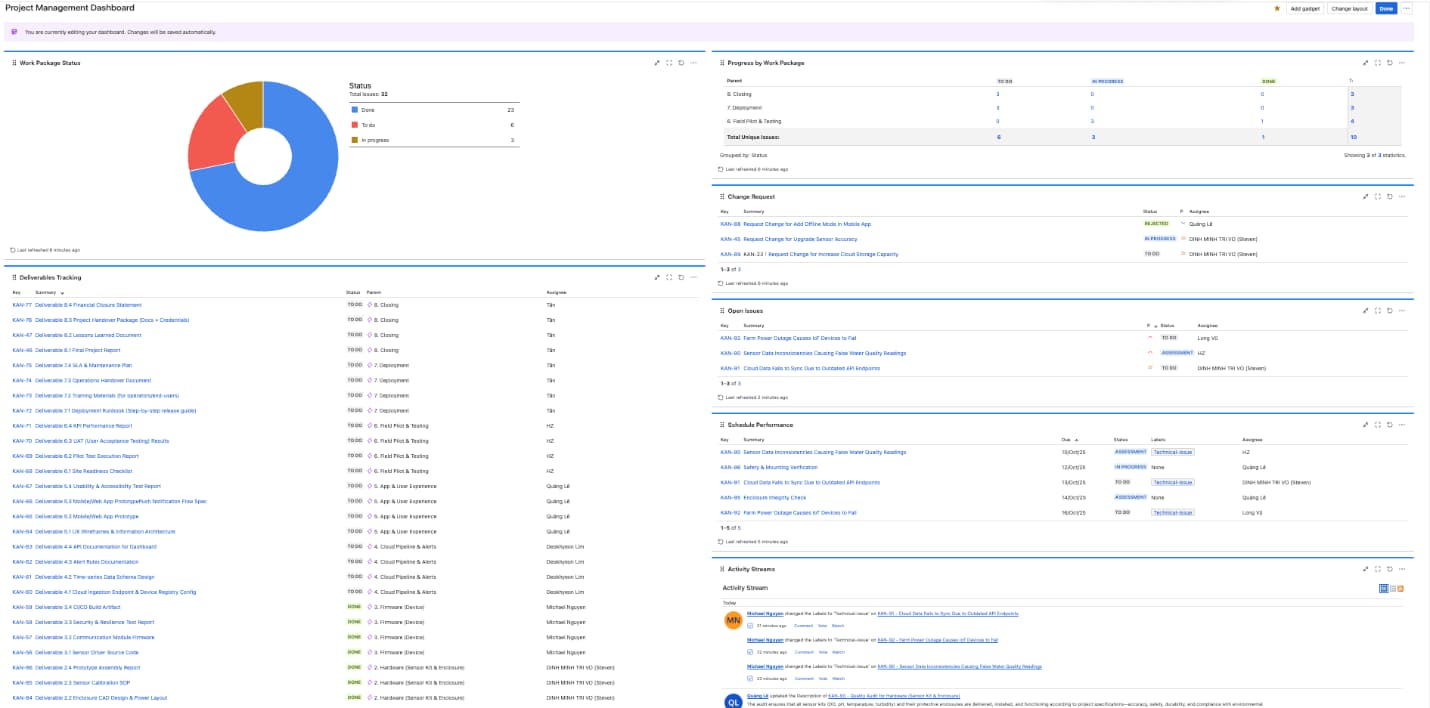
It's a project-management exercise rather than a working product, but it's a genuine run at applying formal PM discipline, work breakdown, RACI, change control, quality audits, vendor evaluation, to a technical project shaped like a real one rather than an abstract case study.